Unschooling School: Why School Sucks and How Teachers Can Do Better in a System That Won’t

Every afternoon, after the yellow bus rumbles away and my eleven-year-old son climbs into the back seat, I ask the same question parents have asked since the dawn of report cards:
“How was school?”
And every afternoon, I get one of two answers. “Boring.”
Or, on a good day, “Mid.”
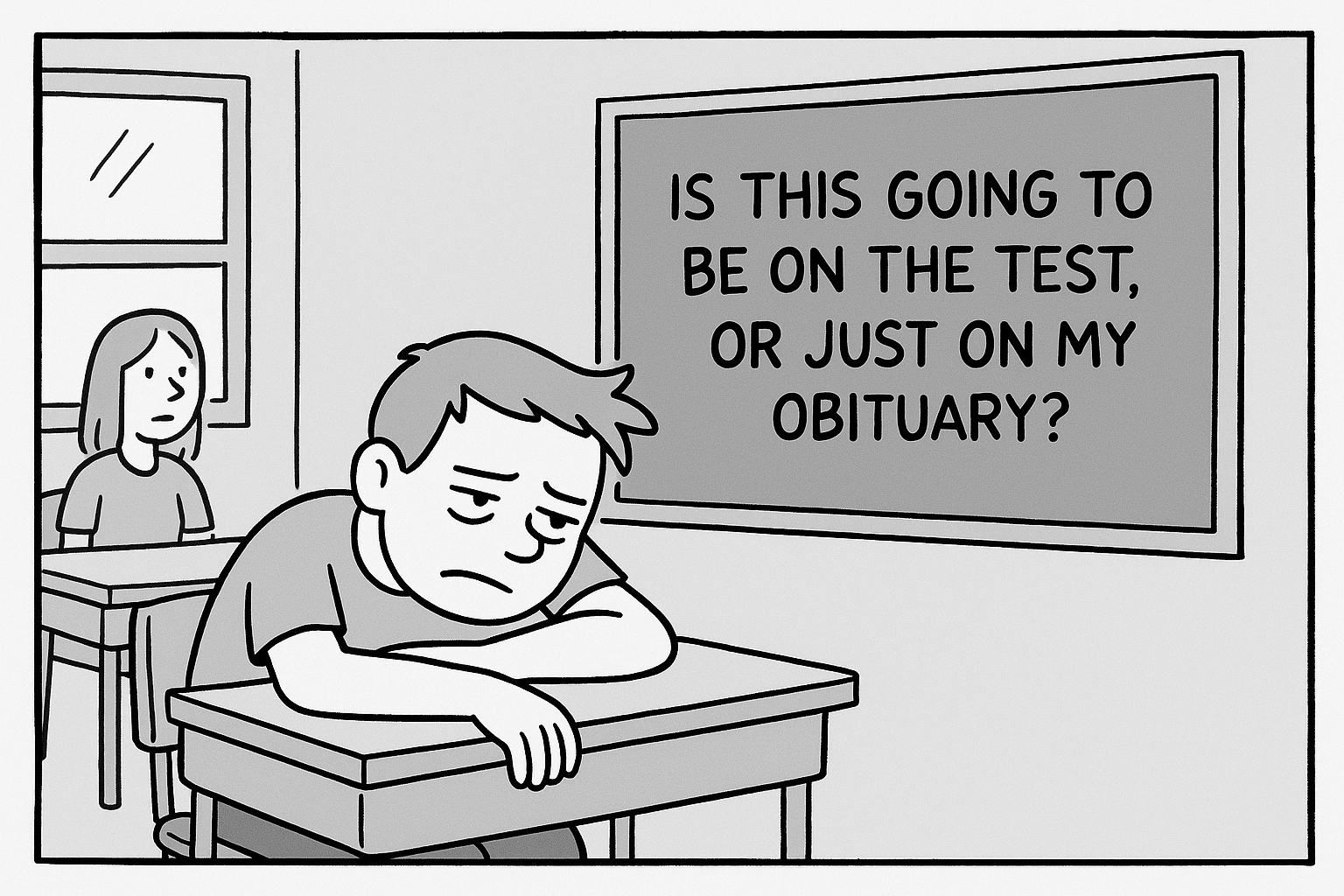
That’s it. One word. Every day. No detail. No spark. Just the dull thud of indifference. I wish I could say that at first I thought it was just him being a kid, but even though Adam is pretty gifted at learning, when it comes to liking school he’s not an outlier. He’s the norm. His reaction is the collective shrug of this generation—and many before it—legions of kids trapped, trained, and tamed by a system that confuses compliance with learning and busy work with growth. The kids aren’t broken. The system sucks.
But who am I to make this claim? Who am I to dare write about unschooling school?
I’m not an academic who spent his life researching important topics in education. I’m not a philosopher full of education-altering wisdoms. I’m definitely not a self-help guru capable of solving education’s problems with a catchy slogan-turned-acronym and a bullshit morning routine.
I’m a teacher.
I’ve spent my life inside the educational system—first as a student trying to learn and now as a teacher constantly learning how to learn, teach, and help my students learn. Above all, I’m continually hard at work unlearning the teaching habits that get in the way of my students’ learning and reimagining the educational policies that stunt their growth.
For the last forty years, I have had the front row seat to the tomfoolery that is modern day schooling and my soon-to-be-released new book Unschooling School: Why School Sucks and How Teachers Can Do Better in a System That Won’t is the next step on my journey to unraveling its motives, challenging its methods, and offering teachers a way to fight and counteract its shortcomings from within their classrooms.
I did not know it at the time, but my journey through the educational system began in the communist Poland of the 1980s where school was mostly about obedience, order, and mindless memorization of way too many facts. You didn’t question. You weren’t supposed to wonder. You just followed instructions, memorized facts, and learned to stay invisible to avoid “odpytywanie,” or being called to the board—a frequently practiced psychological torture tactic utilized by teachers to show students how unprepared for adulthood and self-determination we were. If a teacher didn’t like you, they’d ask questions so specific a “1”—the Polish version of an F—was guaranteed.
A typical class in the Polish elementary school of my youth involved the teacher doing most of the talking and students silently copying information from the blackboard or the textbook into our notebooks. Any student interaction was met with harsh teacher disapproval (or punishment) and questioning the teacher was out of the question.
Fast forward to my Chicago arrival in 1992, I expected something radically different. And in a way, it was. The posters were brighter, the desks newer, and the creativity quotes more prevalent. But the teaching and the learning were the same. Compliance over curiosity. Control over wonder. Efficiency over creativity.
Call it what you want—academic rigor, high standards—it was still obedience, order, and the same old mumbo jumbo designed to keep the adults comfortable and the kids compliant, packaged in a shinier wrapper. Different system, same trickery.
And then, I became part of the problem. Not a cog—by design this distinction is reserved for our students—I, like so many teachers, served as the grease that helps the machine that is the established educational, political, and socio-economic order run as intended; smoothly, predictably, efficiently.
My debut in the profession occurred in 2003 as an Environmental Science teacher in Chicago Public Schools—fitting, since I was completely unfit to read the needs of my most immediate environment: my students. I didn’t know what the hell I was doing, but I had a lesson plan template and the kind of idealism that makes you easy to break in. Plying this noble (or so they say) trade in a Black Belt high school I observed, though did not realize at the time, how schools were not designed for minority nor disadvantaged students. I did what I was trained to do: follow the standards, enforce the rules, deliver the content. I expected my students to comply with whatever I was taught to comply with. I expected them to follow the same rules I was forced to follow. I expected them to tough it out, because I toughed it out not too long before they had to. Maybe I was a cog after all and the grease to boot. I struggled as both.
Four years and a 2007 Minnesota transplantation later, I continued as an Earth Science teacher at something called the “On Track Program,” which sounded encouraging until I saw it and realized it was a haphazardly assembled holding cell for maybe forty, mostly minority students deemed unworthy of passing eighth grade. In an unprecedented move, St. Paul Public Schools (SPPS) labeled them “not ready” for high school until they were steered onto the “right track.”
I, of course, had zero clue what that track was—though I killed it at the job interview, being well-indoctrinated into the machine. I did not even know that I didn’t know what the right track was, because by then I was well-experienced in the “right way” of removing individuality, promoting obedience, and forcing compliance with torture tactics... I mean consequences such as isolation and exclusion from activities that made school barely bearable. So I did what every good teacher does when lost: I implemented these tried and true methods and wondered why they didn’t work. The struggle was real.
The next year, I leveled up—or so I thought—to teaching eighth-grade Earth Science, regular and IB (International Baccalaureate), at a proper SPPS junior high. The schedule was standard-issue and so was the job, but I started to realize that the kids never are. “Why would we treat them as such?,” I thought. Five years in, purporting I was making a difference, I began to suspect I might just be oiling the gears of futility.
For one, how were the students selected into the regular vs. the advanced IB track? The SPPS website states the pathway is open to all “motivated” students, which is commendable, but in reality, access is often limited by circumstances many minority and low-income students face such as poor academic preparation, working or caring for siblings after school, or the implicit school bias. As a result, existing inequities are perpetuated, despite best intentions.
My two IB classes modeled this; they were made up mostly of white, well-off kids with “adequate” Minnesota Comprehensive Assessment (MCA) scores. The three regular science classes I taught consisted mostly of lower-income Hmong, Hispanic, East African, and African American students. They weren’t any less capable—just never given the same invitation to the IB table. I still struggled, but at least I was starting to understand how the system works.
After a shitty, stressful summer of 2009 that began with me being pink-slipped by SPPS due to budget cuts, I crushed another job interview and was hired by the South Washington County Schools to teach high school science. I remember the since-retired principal mentioning something about good PR and the science department chairman telling me that she frequently reiterates to him “she doesn’t want her phone to ring,” meaning the principal did not want to have to deal with dissatisfied parents or other bad PR. That’s when I learned that as long as it looks good in the public eye, a school will be seen as “good”—and my job was more about keeping up this illusion than actually teaching students.
A school might even earn the title of “one of the best public schools in America” from outlets that wouldn’t recognize real learning if it hit them in the ass—U.S. News, for instance—using measures like state test scores and “college readiness,” mostly defined by ACT or SAT results. In lieu of such a groundbreaking achievement, a school might plaster a giant poster of the recognition by the main entrance to shout its “top” status. Alas, twelve or so years into my career, I finally grasped the holy grail of teaching: becoming a “good” teacher isn’t about the skills my students acquire or the understanding they gain—it’s about how efficiently and effectively I can train them to jump through standardized-test hoops to make the institution they attend look good.
Now, as a science teacher who’s spent the last ten years of my 23-year teaching career studying, applying, and writing about learning theory and evidence-based strategies, I can tell you that what we call “education” has very little to do with how people actually learn. Our schools were built and are still wired for industrial-age outcomes, not for 21st-century humans. While curiosity and inquiry are preached, classrooms are optimized for predictability and teachers are trained to maintain order.
We plead with our students to think critically but reward remembering rather than reasoning. We measure performance, not understanding. We confuse grades with growth. And worst of all, we train teachers—good, caring, intelligent people—to perpetuate this compliance porn because “that’s the way we’ve always done it.”
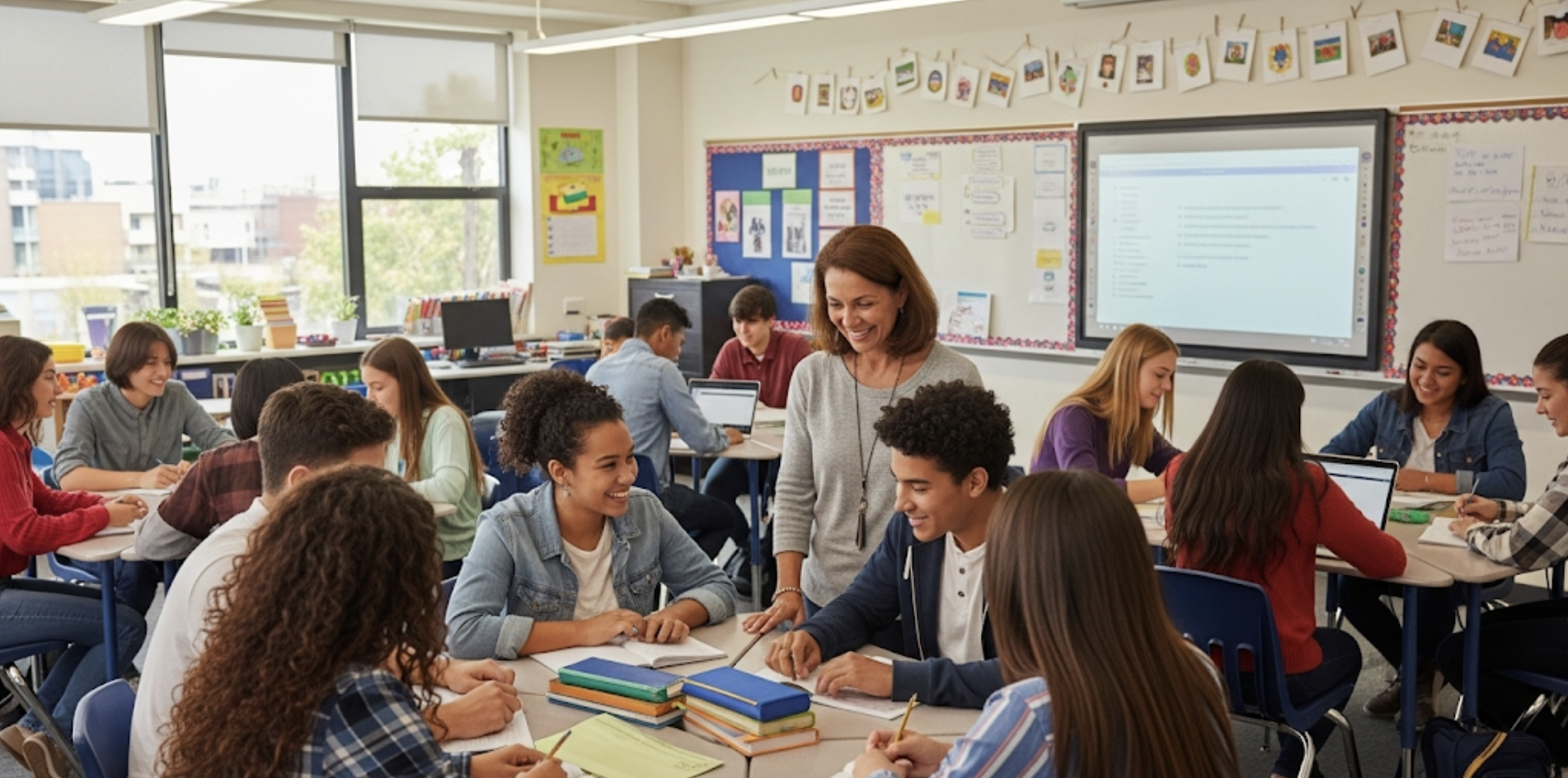
But here’s the truth: while we cannot fix the system, we can unschool schooling. Individual teachers can rebuild their classrooms around how the human brain really learns—through emotion, curiosity, connection, and purpose. We can create classrooms that make kids want to come back the next day—not because they have to, but because their minds are stimulated. We can stop wasting the most powerful force in the world: the natural human drive to make sense of things.
Because the educational system won’t do it. It can’t, because it is a behemoth that requires a complete overhaul; a revolution. It’s grown too large, too familiar, too comfortable. It’s protected by federal, state, and local level redundancies. No one person or a group of individuals can undo it.
But while we may not be able to fix schooling at large, we can debug our students’ learning experience. We can, in the words of Mark Twain, refuse to let “schooling interfere with [their] education.” We can raise thinkers and owners of their own destinies in spite of the system built to produce followers of someone else’s agenda.
That’s what my new book Unschooling School is about—turning student miseducation and frustration with schooling into teacher action. It’s not just another rant about what’s wrong with modern day education.
It’s a roadmap for making learning less about what the system demands and more about what our kids need to make smart, thoughtful, and more impactful decisions.
It’s for teachers who know there’s more to this job than testing, grading, and managing behaviors.
It’s for teachers tired of witnessing kids’ spark for learning turn into apathy toward school.
Most of all, it’s for those asking the question: Can we do better?
We can.
We must.
We bear the responsibility to unschool our students’ education before the system drives curiosity and wonder out of another generation—before another kid answers “boring” or “mid” to a question that should light up his eyes and spark her smile.
Thanks for reading this excerpt from my new book: Unschooling School: Why School Sucks and How Teachers Can Do Better in a System That Won’t coming out at the end of Summer 2026.
Please let me know what you think about this idea in the comments below.
BOOKS & TOOLS


![[Earth & Space Science] Cosmic Scene Investigation: A Case of the Kilonova](https://images.squarespace-cdn.com/content/v1/5611dbcce4b0b27692201460/af009c00-4e48-4f80-a91c-3a7899d66828/Cosmic+Scene+Investigation_+A+Case+of+the+Kilonova.png)

![[Earth Science] Terraforming Mars: The Red Planet](https://images.squarespace-cdn.com/content/v1/5611dbcce4b0b27692201460/cf20dede-a655-4803-9af0-1ef1b49c8747/Terraforming+Mars_+The+Red+Planet+_Shark+Tank_+Innovation+Challenge.png)


- December 2025 1
- September 2025 2
- August 2025 5
- July 2025 4
- June 2025 2
- August 2024 2
- July 2024 2
- June 2024 1
- October 2023 1
- September 2023 3
- August 2023 6
- July 2023 6
- July 2022 2
- June 2022 1
- November 2020 3
- October 2020 3
- April 2020 1
- March 2020 5
- July 2019 1
- June 2019 1
- April 2019 1
- January 2019 1
- November 2018 3
- October 2018 2
- September 2018 1
- August 2018 8
- July 2018 11
- June 2018 4
- May 2018 5
- April 2018 2
- March 2018 4
- February 2018 5
- January 2018 3
- December 2017 1
- November 2017 5
- October 2017 7
- September 2017 6
- August 2017 5
- July 2017 3
- June 2017 10
- May 2017 7
- April 2017 7
- March 2017 15
- February 2017 12
- January 2017 13
- December 2016 15
- November 2016 8
- October 2016 7
- September 2016 12
- August 2016 14
- July 2016 10
- June 2016 13
- May 2016 10
- April 2016 8
- March 2016 5
- February 2016 7
- January 2016 6
- December 2015 5
- November 2015 8
- October 2015 2